
Published on
We held the first Addepar Enterprise Summit last week, with leaders from firms representing some of the largest private banks in the world. During the summit, we heard from expert speakers across a series of insightful keynotes, roundtables and panels.
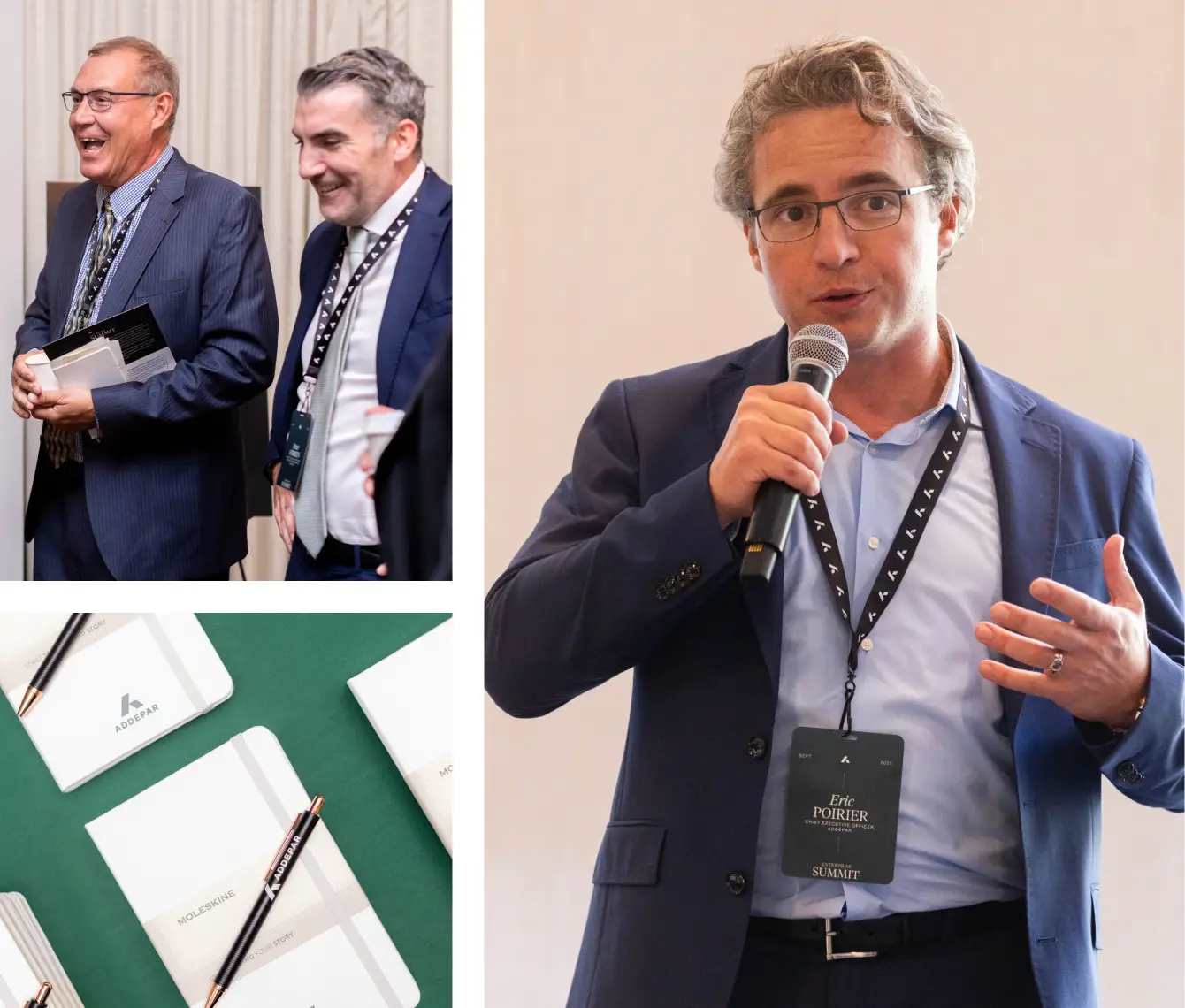
The discussions focused on tech modernization and AI, alternative investments, and evolving client expectations within private banking. Here are our five key takeaways:
1. Culture powers technological transformation
Embracing change, fostering curiosity and moving quickly is
key to success in a rapidly evolving technological landscape.
This was a recurring theme throughout the conference: a
company's culture is often deemed even more important
than its strategy for technological transformation. For
example, one enterprise client’s significant tech investment
was cited as a reason for its continued dominance in the
industry, highlighting their commitment to a culture of
ongoing innovation.
The consensus amongst attendees
is that technology is only as effective as the culture that
adopts it, with the biggest hurdles to innovation often being
organizational rather than technological. Speakers framed this
organizational shift as "culture eats strategy” and
“yesterday’s playbook will not solve tomorrow’s
challenges."
2. Data adds value when treated like a product
Treating data as a product requiring governance and quality
control is fundamental to thriving in an AI-driven world. As
one speaker put it, "Data is a product, not a
byproduct." Further, data should be treated with the same
rigor as any other product, complete with governance,
contracts, traceability and methodical management.
With
alternatives now a core portfolio component — nearly 40%
allocation in many cases — alts are no longer alternative. The
primary challenge for investment managers in the private
markets is a data challenge, and the friction caused by manual
processes, inconsistent reporting and a lack of transparency
and timeliness. A robust platform is essential for creating a
single, standardized source of truth for alternative
investment data and providing a clear view of multi-asset
class portfolio performance to make informed, timely
decisions. The next frontier is to systematically reduce the
friction points and provide consistent, transparent
benchmarking data to a broader range of investors, from large
institutions to the retail channel.
3. Human oversight generates trust
While AI is a powerful accelerator, it's not a
replacement for human expertise particularly when it comes to
softer skills. While many interpersonal skills can be
simulated or augmented by technology, the deep, nuanced
aspects of handling sensitive, high-stakes client
relationships remain distinctly human.
Using human
judgment to validate and refine AI-generated insights is vital
in combating errors and biases. The problem of AI
hallucinations — generating incorrect or nonsensical
information — was a key concern repeated throughout the day.
From a business perspective, participants said their AI model
is only as good as the data it is trained on. Therefore, both
data quality and model performance must be continuously
assessed. Summit participants also support a multi-step,
human-in-the-loop approach, with human advisors applying their
judgment to AI recommendations.
4. Speed creates advantage
Another key takeaway from the Enterprise Summit was
"agility is the new stability." Speakers emphasized
the need for a cultural shift away from slow, risk-averse
processes to one of taking risks and failing fast. This
cultural style is enabled by a focus on continuous and
incremental innovation — an approach that can be a critical
differentiator.
Partnership is another innovation
model because no single company can tackle the complexities of
modernization alone. This means building an interoperable
ecosystem with companies like Addepar and our partners that is
“symbiotic.” This approach moves firms from siloed operations
and homegrown solutions to plug and play where they can get
"further faster."
5. Client needs should guide modernization
Enterprise firms are focusing their modernization efforts on solving real business and human challenges, more so than a desire to implement the latest technology. Firms caution against "tech for tech's sake." Instead, every modernization effort must be tied to a clear operational issue or client need.
In terms of operational challenges, firms are looking for process inefficiencies they see as signals or red flags like using a large number of disparate apps daily or long data-to-insight cycles. These flags are clear indicators that a business process needs to be re-evaluated and modernized.
From a human perspective, enterprise firms are asking themselves: "What value does this bring to the client?" Their ultimate goal? One speaker summarized it this way, "Get obsessed with the client problem and what you want to solve for." Firms are moving to ensure new technologies bring tangible value in the form of revenue, efficiency or a better client experience.
Learn more about how Addepar supports enterprises.